Monday, August 6, 2012

Seed Determination, part 2

This is the first follow up to my "Seed Determination" series...  

It's been almost two weeks since sowing seed representing ten succulent genus, see Seed Determination.  Of these, five have sprouted:  Faucaria, Odontophorus, Lithops, Aloinopsis, and Echinocereus.  Culture has been the same for all ten genus (baggie method), and consistent with past sowings, the same genus' have the strongest showing. Also, I sowed a couple of dozen Lithops in one larger pot, yet there are only five sprouts, all located at the perimeter of the pot despite the highest concentration of seeds being sowed toward the middle.  Not sure why that occurred, but it may have to do with water condensing and/or heat emitting, from the pot walls. 

I removed the baggies from all pots after a week and have been misting twice a day.  Temps are unusually cool, nights in the 60's (F), days in the 70's.  Still hoping for signs of life from the other pots!

Here are photos of the strongest seedlings.  Others are too small to photograph.  More updates to follow.....
Faucaria kingiae

Aloinopsis orpenii 
AKA Prepodesma orpenii

Thursday, August 2, 2012

Survival of albino Aloes


This is an Aloe nobilis
variegata.  Pups are continously growing from her base - all
variegated. The variegation patterns are widely varied, ranging from almost full green to albino*.  Striping is light to dark green, often turning red/brown in full sun.


Closeup of albino* pups
*In the context of this post, "Albino" are plants with very little chlorophyll.

I was curious if the albino forms would survive on their own.  I removed four similarly sized pups, three albino and one standard, and situated them in half day sun. This is a photo of the four pups a few months after removal.  The standard form has grown twice as large as the albinos and has begun to produce pups.  


More recently, I removed these four pups and planted them in the same pot.  They represent a wider range of variegation.  There is one almost completely white specimen.  Curious to see if it survives.


This pup was lightly variegated and unlike the others, took on the reddish "stress" colors of the mother plant.  


Of the first group, only this one and it's green sibling, survived.  The other two turned brown and died.  This plant is exhibiting the same problem, browning of the leaf margins.  Plants in the second group have survived so far.  All but the whitest plants, regardless of the proportion of green to white, did very well.  On some plants, green stripes have thickened, but the all-white leaves never developed new striping and are weaker and more sensitive to light.  They cannot tolerate much direct sun, yet do poorly in bright, full shade.  They seem to do best in dappled shade with a dose of early morning, direct sun.  I am still experimenting with exposure.  


I can only conclude that the albino plants, lacking in chlorophyll, are weaker, less tolerant of light/sun, and grow much more slowly than their greener counterparts, if they survive at all.  More updates to come....!

Friday, July 27, 2012

Desert Garden ~ Balboa Park

Whether a visitor or resident of San Diego, you will probably visit Balboa Park.  It is one of the gems of our city.  There are several notable gardens within the park, one of which is a cactus/succulent garden or Desert Garden, established about 70 years ago.  As a plant enthusiast and succulent collector, I find myself walking through here many times a year. Here are a few photos from a recent visit.  Notice the number of very large, old specimens.

Western end of garden


Old, very tall Yucca


Euphorbia ingens

Aloe barbarae


Opuntia

Huge clump of Agave attenuata, growing in shade.

Below:  Although disturbing, I thought I would add a few photos of what tends to occur in public gardens ~ vandalism by graffiti.  Fortunately, most plants either cannot be carved or they have enough spines to protect themselves.  Opuntias and agaves are the primary victims.  Such a shame!


Back to the more natural....

Blooming Crassula falcata growing under cactus


Unknown Opuntia with very large pads.  Some were over 12" in diameter.
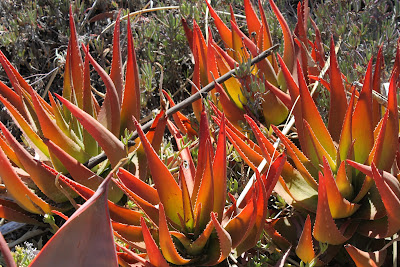
This clump of aloes looked like flames of fire


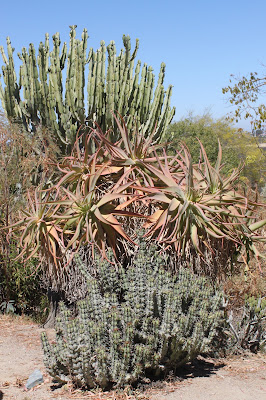
Aloes and euphorbias

 Aloe dichotoma
Loved this combination!


The Opuntias were all forming fruit.  Guess I'll have to visit again when they ripen!


Wednesday, July 25, 2012

Seed Determination

Faucaria kingiae Grahamstown
Batch 5 sowed 6/11/2012

A couple of years ago I was introduced to the art of growing succulents from seed.  I never considered the possibility until an online succulent enthusiast and friend, posted photos of plants he germinated from seed.  You may know him through his blog Little Treasures of Life (LT).  I was in awe of his "babies".  LT had an amazing collection of seed sown mesembs, aloes, and other succulents.  I couldn't wait to take up this new venture!! Armed with an online order of seeds and detailed instructions, I sowed my first batch.  I will never forget how excited I was to see tiny green specs peeking out from between granules of sand. I did it! How difficult can this be?

That was two years and about five batches ago.  I've had amazing successes, and even more failures:  Too dry, damping off, too cold, too leggy, low/no germination, mildew, etc.  I teetered between discouragement and determination but in the end, the reward of owning succulent plants from far regions of the world, that I planted myself, made it all worth it.  

This is a documentary of my most recent seed starts.  I am still on the low end of the learning curve, so this will be at least interesting and at most....I will have lots of new babies!


Batch 6 sowed 07/24/2012
Lithops - Faucaria - Cephalophyllum - Aloinopsis - Odontophorus - Argyroderma
Sclerocactus - Echinocereus - Ferocactus - Gymnocalycium
Watered and topped by plastic wrap.  Placed in bright shade.


The Medium
2/3 equal amounts of perlite and course sand; 1/3 cactus mix potting soil (all sterile).
Seeds are covered by a layer of course sand topped by fine sand.


Next post....germination!